The Queen Found Princess Diana Crying After Speaking to Camilla — Her Response Changed Everything

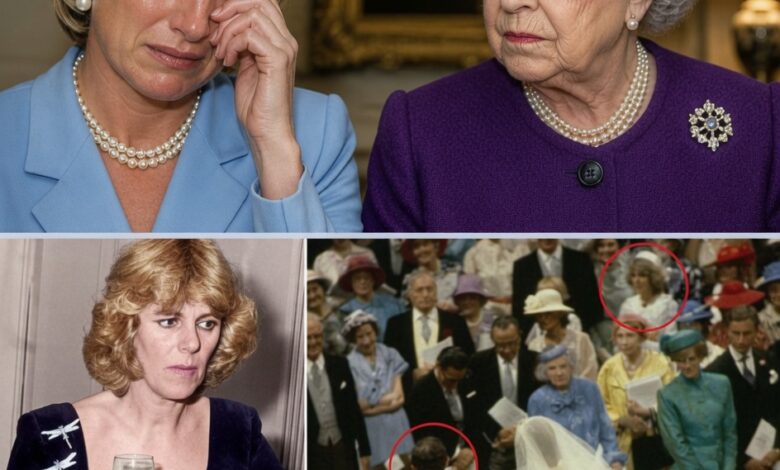
The Queen Found Princess Diana Crying After Speaking to Camilla — Her Response Changed Everything

The queen did not knock the second time. The first had been light, almost polite, the kind of sound people made in large houses when they already suspected they were interrupting something private. But when no one answered, she opened the door herself.
Diana was standing by the window with one hand against the glass and the other pressed over her mouth. The telephone receiver hung beside the small table. Not dropped, not replaced, just left there gently swaying. Her shoulders were too tight. One shoe was half off. The tea on the tray had gone untouched.
For a moment, the queen said nothing. She had spent too many years in rooms where emotion arrived late, if at all. Still, she noticed things. The silence after a call, the posture of someone trying not to be heard crying. The way Diana did not turn around immediately as if she needed those extra seconds to become princess again.
Then the queen asked very quietly, “Was it her?”
Diana lowered her hand, looked at the carpet, and nodded.
The room was quiet. The receiver moved once more, then stopped. And in that stillness, before another word was spoken, something had already changed.
Earlier that afternoon, everything had looked ordinary. Lunch had been served on time. Doors opened before anyone reached them. Conversations moved with the careful rhythm of people who knew how to say enough without saying too much.
Diana had smiled when expected, listened when expected, and felt with growing unease that everyone around her understood the shape of the day better than she did. Not the schedule, the arrangement.
She was still young enough to believe effort could fix what instinct was already warning her about, still hopeful enough to think that marriage once official enough, public enough, blessed enough, would naturally push the past aside. But there are some histories that do not leave because a ceremony asks them to.
The message came through the switchboard with almost no drama. There was a call for the princess. Nothing unusual in that. Yet something in the footman’s expression, too careful, too neutral, told her more than his words did.
“Camilla.”
No title, no explanation, just the name spoken softly, as if everyone in the building already knew fewer syllables made it easier to carry.
Diana took the call in a smaller sitting room down the corridor. She closed the door, but not fully. Closed doors attracted attention. Halfopen ones only invited guessing. When she lifted the receiver, she arranged her voice before she spoke. That was already becoming a habit.
Camilla’s voice, when it came through, was calm, not sharp, not triumphant, and that made it worse. Cruelty can be resisted. Calm certainty is harder. She asked after Diana in a tone so settled it almost sounded intimate. There was no rush in her, no hesitation, no sign that she felt she was crossing a line. She sounded like someone speaking from inside a life rather than reaching toward one.
Diana answered carefully at first, too carefully. She was still trying to be correct, as if correctness could protect her. But then Camilla said something small, almost casual about Charles being difficult when he felt under pressure.
And Diana went still.
It was not the sentence itself. It was the ease inside it, the ownership, the quiet assumption that she knew his moods before they arrived, knew which version of him came home after a disappointing day, knew what he sounded like when he was tired, which silences meant irritation, which meant retreat. She had the older map.
Diana looked down at the carpet while Camilla spoke. She said yes too quickly. Twice, smiled once, though no one could see it. Her fingers tightened around the receiver. A pause opened, then closed again.
By the time the call ended, the pain was no longer confusion. It was recognition. This was not another woman on the outside. This was continuity. And that realization landed harder than jealousy ever could. It stripped away the last comforting fiction that time, marriage, photographs, and public approval would naturally place everyone where they belonged.
When Diana lowered the receiver, she did not set it back properly. She turned away first. Then the tears came, sudden and silent, with the shock of someone realizing she had been standing in the wrong story.
The queen had been crossing the corridor for reasons so ordinary they barely mattered, a paper left unsigned, a remark to a private secretary, one of the dogs somewhere ahead. That was how these lives worked. The important moments rarely announced themselves. They arrived disguised as interruptions.
Then she saw the halfopen door and the hanging receiver before she saw Diana’s face. And once she saw it, she stopped just inside the room, not rushing forward, not stepping back, giving the younger woman the strange courtesy of being witnessed without being fussed over.
Diana turned at the sound of the door. Her eyes were wet, but it was the effort to control herself that made her look younger. For a second she seemed almost angry at being found. Then the anger vanished, and what remained was humiliation.
“She spoke as though I were the temporary one.”
Diana said it came out flat. No drama, no tremble, just the exhausted precision of someone who had already replayed the wound twice in her head.
The queen moved to a chair and sat down. Her gloves stayed folded across her lap. Even now she looked composed, but she was listening.
“Come away from the window,” she said.
Diana obeyed, though not immediately. She wiped at her face with the side of her hand, then seemed to remember herself and reached for a handkerchief instead. Even in distress, she was aware of posture, of manners, of being observed. In houses like that, one learned early that pain was easier to forgive than mess.
What Diana wanted in that moment was difficult to name. Comfort, perhaps, but not the sentimental kind. Contradiction, maybe. Someone older and steadier telling her she had misunderstood the voice on the telephone, that it meant less than it sounded. But the queen was not a woman who rushed to soften a truth.
Diana sat on the edge of the chair rather than fully into it. Her back stayed too straight. The room was quiet again.
“I thought marriage would settle it,” she said.
That sentence carried more than she intended. The ring, the cathedral, the applause, the photographs clipped from newspapers and saved in drawers. It carried every kind reassurance she had been given by people who spoke about royal life the way one speaks about weather. Difficult, yes, unpredictable, yes, but survivable. No one had told her that survival and happiness were not the same thing.
A memory flickered through her then, a younger version of herself being prepared for the wedding, older women adjusting silk, straightening seams, telling her nerves were natural, telling her things would calm once she was inside it all, as if being inside guaranteed belonging. But public acceptance and private security were never the same currency.
Outside, everything had shouted permanence. Inside, permanence behaved differently. It lived in old habits, old loyalties, old understandings. It moved quietly through country weekends and remembered jokes and names spoken without explanation. Diana had been adored almost overnight, but private systems were older than public love. They did not always resist openly. Sometimes they simply waited.
“She knew how he’d been feeling before I did,” Diana said at last. “Do you understand?”
The queen looked at her for a long second.
“Yes,” she said.
That yes hurt more than Diana expected. Not because it was cruel, because it was unsurprised. A pause. Diana looked down at her hands.
“Then why am I here?”
The question was so bare it seemed to remove the room around it. No title, no pageantry, just a young wife asking what place remained for her, if someone else already understood the man she had married better than she did.
The queen did not answer at once. She adjusted one glove against the other, though it did not need adjusting. Then she said, “Because duty and affection are not always the same thing.”
“That’s not enough,” Diana said.
She answered too quickly, but she did not take it back. The queen held her gaze. Diana’s breathing slowed, her eyes sharpened. Something defensive in her was giving way to something clearer.
“Am I expected,” she asked, “to pretend I don’t see it?”
The room was quiet. Somewhere downstairs, a door closed. The receiver still hung beside the table, now perfectly still. The queen looked toward the fireplace, then back at Diana. When she spoke, her voice was lower.
“You must decide whether you want peace or whether you want the truth. This family rarely gives both.”
That was the sentence. Not loud, not dramatic, but it landed with the finality of something that had been true long before Diana asked to hear it. It did not comfort her. It did something more dangerous. It clarified, and clarity can be the beginning of defiance.
Diana said nothing for several seconds. She looked as if she wanted to reject the words, to argue with them, to insist that love should not have to choose between honesty and survival. But the expression did not fully form. Because somewhere beneath the hurt, she already knew. The queen had not rescued her. She had simply refused to lie.
The queen rose first. For one second, Diana seemed to think she might walk to the telephone and place the receiver back, restoring order in one neat gesture. But she did not. She left it hanging. Instead, she said, “You have two boys to think of. Never forget where your real leverage is.”
It was a practical sentence almost severe. Yet it reached Diana more deeply than sympathy would have because behind it was recognition not of the romance, not even of the wound, of the mother, and that in that moment Diana trusted.
The next morning, the house looked as if it had slept well. Breakfast appeared under silver lids. Newspapers were folded to the right pages. Staff moved with the same smooth precision that always made emotional disaster seem faintly impolite.
Diana came in later than usual. Her face was composed, but her eyes gave her away to anyone paying attention. William was young, but not too young to notice. He looked at her across the table and asked, in the direct way children do, whether she had a cold.
Diana smiled, “Just tired.”
He studied her for another second before looking down at his plate. He did not fully believe her. Children often recognize sadness before adults decide what to call it.
The queen lowered her newspaper and glanced once at Diana, holding the look half a beat longer than usual. No smile, no acknowledgement of the previous afternoon. Nothing anyone else at the table could have named, but Diana saw it. A signal perhaps that what had been said remained true in daylight, or maybe simply a refusal to let the moment be denied now that it had happened.
A spoon touched China. Someone mentioned the weather. William swung one foot beneath the table, and there it was again, that peculiar royal skill surrounding extraordinary tension with ordinary sounds until the whole scene appeared stable from the outside.
Later, alone with the boys, Diana found herself watching William more closely. The way he looked at faces before speaking, the way he moved nearer when he sensed sadness, not because he understood it fully, but because he recognized its shape. That changed something in her, too. It made the problem less private. No longer only a wound between adults, but an atmosphere children might learn to live inside if she did not change it.
The queen had not told her what to do next. She had offered something colder and more useful than advice, a frame. Stop asking whether you are loved enough to stay. Start asking what your silence is protecting.
In the weeks that followed, the shift was subtle. Diana still smiled when she was meant to smile. She still stepped from cars with that impossible blend of shyness and radiance people found so affecting. She still performed the visible part of the role, but underneath the questions changed.
Less, how do I make this work? More, what exactly am I being asked to carry? Less, can I win him back? More who has already decided the shape of this marriage besides me.
That is how power begins to move in private lives. Not always with declarations, sometimes with better questions, sometimes with a pause where automatic obedience used to be. Sometimes with a woman realizing that being chosen in public is not the same as being protected in private.
The public, of course, saw only fragments. A wave from a car, a glance on a balcony, a photograph frozen at the right angle and sold as proof that all was well. People mistake poise for peace all the time. They see a princess in pearls and assume the story beneath the pearls must also be polished. They see good posture and call it stability. They hear careful words and imagine nothing sharper exists beneath them.
What they could not see was that one of the deepest shifts in Diana may not have happened during a scandal or a headline or a confrontation anyone remembered later. It may have happened after a phone call in a quiet room while a receiver hung loose beside a table and an older woman finally said the one thing no one else had been willing to say plainly.
And when Diana later spoke to Charles, the difference was not volume. It was temperature. Something in her had cooled into accuracy. She was less willing to circle the truth politely, less easy to soothe with vague phrases about pressure, duty, complexity.
When he looked away, she noticed it differently. When he delayed an answer, she heard choice inside the delay. When he said nothing, she no longer mistook silence for confusion. She understood now that silence could be structure, and once a person sees that, they cannot fully unsee it.
There is a reason stories like this linger. Not because people enjoy pain, but because almost everyone has known some polished arrangement that asks to be protected more than it protected them. That is why Diana’s private moments still matter. The details are royal. The feeling is not.
The loneliness, the guessing, the waiting, the small humiliations no one else is meant to notice. And then one day someone notices.
That evening, after the corridors had quieted and the house had settled into its practiced hush, Diana stood at the doorway of the boy’s room and watched them sleeping. The light from the hall reached only partway across the carpet. She did not go in at first. She just stood there, one hand against the frame, not crying now, not even close.
Somewhere in the distance, a clock marked the hour. A floorboard answered with a small, familiar sound. Then she stepped inside. She bent to smooth a blanket that did not need smoothing. William stirred slightly, then settled again. Harry slept on, unaware.
Diana looked at them for a long time, her expression calmer than it had been the day before, though not softer. Something had hardened, but not cruy, more like a line had finally been drawn, where before there had only been fog.
when she left the room as she passed a small table in the corridor where another telephone sat waiting in the dark. She slowed for a second she simply looked at it as if seeing not an object but a threshold. Then very calmly she moved on.
No speech, no vow, no dramatic ending. Just a woman walking through a silent house with the knowledge that something had ended in her that afternoon and something else clearer, quieter, far less willing to be managed had begun.