Diana Caught Charles on the Phone With Camilla in the Bath — He Didn’t Know She Was Listening

Diana Caught Charles on the Phone With Camilla in the Bath — He Didn’t Know She Was Listening

There is a corridor in Kensington Palace that most people have never seen. Not the grand staircase, nor the rooms where the photographs were taken, just a quiet upstairs hallway with high windows and the evening light streaming in, and doors on one side that led to private bedrooms.
Diana walked down that corridor almost every night. She knew every floorboard, every draft, the way the light changed in autumn when it came through the glass at a low angle and made the entire passage seem softer than it actually was. One night, and she would carry this memory for the rest of her life, she stopped in front of one of those doors.
Not because she intended to eavesdrop, but because she heard his voice, low, sure, calm, and through the wood of that door, she heard him say to someone who was not her: “Whatever happens, I will always love you.”
Most people know the book “Diana: Her True Story,” published in June 1992, the book that stopped the world, the book that unraveled the fairy tale and revealed what was inside it. But the book is not where this story begins. Before the book, there were the cassette tapes. In 1991, a year before publication, while still living in that marriage, still walking those corridors, still smiling for the cameras, Diana sat alone in a room at Kensington Palace and picked up a tape recorder.
She chose Andrew Morton carefully, a journalist she believed would tell the story with honesty. And over a series of private sessions, she spoke into that recorder with a voice that people who have heard the recordings describe the same way: Steady, quiet, precise. She told him things she had never told another living person about her marriage, about her health, about the years of silence, about a closed door and a voice she heard through it, and the exact words that changed everything.
It is on these tapes that this story comes to life. Nothing in it was common, nothing in it was accidental, and nothing in it began on the night she was standing at that door. It began long before that. By the end of this, you will understand something that the headlines never fully captured. Not just what Diana heard through that door, not just the words, or the argument that followed, or the years pretending nothing had happened, but what she did with it, the price she paid for knowing what she knew and for keeping silent for so long, and what it provided her, quietly, gradually, on her own terms, when she finally decided to stop being silent.
Returning to a moment a few days before July 29, 1981, Diana discovered something that should have ended it all. Charles had commissioned a gold bracelet, delicate, with two intertwined letters engraved, a G and an F. Gladys and Fred. These were the nicknames they used for each other, private nicknames, the kind you give to someone when you have built an entire world together, a world no one else was supposed to know.
Diana knew exactly what they meant. She had already known of the existence of Camilla Parker Bowles for months, she knew in that way that young women know things they shouldn’t know, that there was someone else, that there had always been someone else. She went to her sisters. She told them she couldn’t do it. She couldn’t walk down that aisle knowing what she knew, feeling what she felt, carrying all of that alone. Her sisters listened. They were kind. And then they told her, gently, that it was too late. Her face was already plastered on the tea towels. She was 19.
She walked down the aisle of St. Paul’s Cathedral on July 29, 1981, wearing a dress with a 25-foot train, watched by more people than had ever witnessed a single moment in human history. And she described that day, in her own voice, recording it on Morton’s recorder a decade later, as the worst day of her life—not the happiest, the worst. She said she felt like a lamb being led to the slaughter. Those were her words, not Morton’s, not a journalist’s interpretation, but her own. Spoken in a low voice, without drama, into a recorder in a room where no one else could hear.
The early years of the marriage had an atmosphere that photographs could never capture. There were good times, genuine moments. Diana spoke of them too, of how Charles could be charming and attentive when the mood was right. The birth of William and Harry. Certain nights when, for a brief moment, she felt the marriage might become something real.
But Camilla was always there. She wasn’t physically present in the room, never openly, but she was present the way a third person is present in a marriage that is not truly a marriage: in the silences, in the phone calls, in the way Charles’s attention drifted when a certain name was mentioned.
Diana described one afternoon in particular. She was sitting with Charles in his office. They were talking, just talking, the normal conversation of two people who share the same life. And the phone rang. It was Camilla. Diana reflected on it for an instant. She wondered: “Should I be kind? Should I give him privacy?” Then she stood up. She left the room. She closed the door behind her and stood in that hallway, the same hallway, the same quiet hall, and felt something open up, something she didn’t know was still intact. Not because of what she might have heard, but because of the price her own kindness had cost her.
She had chosen grace. She had given him the room. She walked away, as she always did, because that was what was expected of her. And that meant nothing to anyone in that house, except to her. She carried that moment in silence, the way she carried most things in those years, but she didn’t forget it.
Now we come to the night itself. There is no exact date associated with this in the historical records. Diana did not mention a month or a year to Morton when she described the situation. She didn’t need to. The memory was not stored that way. It was stored the way certain memories always are: not as a date, but as a physical sensation. A hallway, a door, a voice coming through the wood.
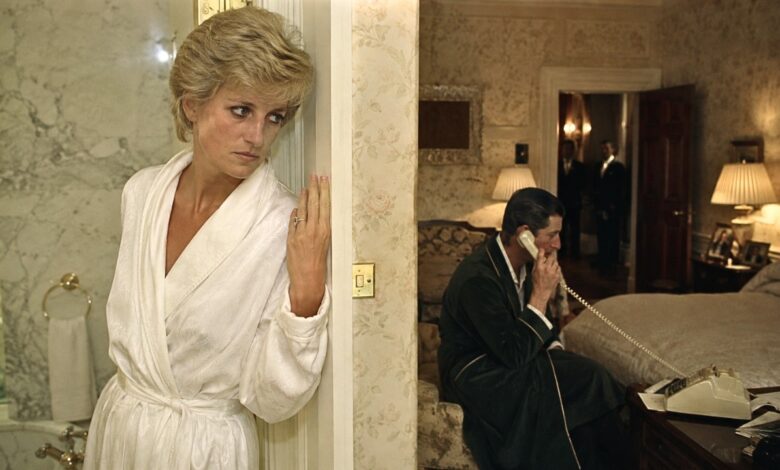
At night, in Kensington Palace, the private quarters upstairs, away from the staff, away from the parts of the house facing the public, which existed for photographs, engagements, and the staging of a marriage that had long ceased to exist in any real sense. Charles was in his bathroom. Door closed. He had a handheld phone, the kind that was still relatively new at the time but still seemed modern and gave the person a false sense of privacy. He was talking to someone. Diana was in the hallway. She hadn’t gone there to listen. That is the detail that matters.
That night, she wasn’t suspicious of anything in particular, or rather, she always carried a low level of suspicion by then. The way you carry something that has been with you for so long that it no longer feels like a weight. She was simply walking, strolling through her own home, when she heard his voice through the door. Calm, unhurried, sure. The voice of a man who believed he was completely alone.
She stopped. And then she heard the words. In her own voice, recorded a decade later, steady and precise on Andrew Morton’s recorder, Diana described everything exactly as it happened. “Once, I heard him on the phone, while he was bathing, on his portable device, saying: ‘Whatever happens, I will always love you.’”
That was it. That was the phrase. She stood on the other side of that door, without moving. Analyze those words for a moment, because they matter. “Whatever happens.” Not “I love you.” Not “I have always loved you.” Not even “I will always think of you.” “Whatever happens.” That is the language of a vow.
That is what you say to someone when you promise them something that exists completely out of reach, outside your marriage, outside your children, outside your duties, your titles, and the life the world sees. “Whatever happens” means that none of that affects this. Diana understood exactly what she was hearing.
She didn’t move. She listened. And when he finished, she waited. What happened next is something Diana was equally clear about in those recordings. She didn’t go to bed and stay silent. She didn’t put it in the collection of things she shouldn’t know and shouldn’t mention. She told him. She told him she had been at the door, that she had heard, that she knew exactly what she had heard, and that she wasn’t going to pretend otherwise. And in her own words, recorded a decade later, without any trace of acting in her voice: “We had a nasty fight. Charles didn’t deny it. He didn’t offer an explanation. He didn’t try to comfort her, nor did he give her anything to lean on. He became cold.”
Diana described this coldness specifically. The coldness of a man who has been caught and who, in the moment of apprehension, decided that the appropriate response is not remorse. It is contempt. That coldness told her more than the phone call. The phone call confirmed what she already suspected. The coldness told her something she hadn’t allowed herself to fully believe until that moment: that she was alone in that marriage in a way that would not change, that there was no version of this that ended with him choosing her, that the woman on the other end of the line was not a mistake, a weakness, or something that belonged to the past. She was the focal point.
Before that night, Diana had managed, through willpower, hope, and the exhausting effort of a young woman trying to turn something non-existent into something real, to keep alive the version of the marriage she had in mind. Painful, imperfect, but still a marriage. After that night, she couldn’t anymore. The phone call through the door wasn’t where the affair began. It was where her willingness to look away ended.
She was 29 years old, mother of William and Harry, Princess of Wales, one of the most photographed, recognized, and written-about women on the planet, and she was standing outside a closed door in her own home, in a hallway she knew by heart, learning again, as she had learned so many times before, that she was the only one in that marriage who was still trying.
Diana understood exactly what she was creating. She knew the recordings were dangerous, not for Camilla, not even primarily for Charles, but for her, for her position, for the carefully constructed image that the palace had taken years to craft and that she had been forced to maintain for years. She made them anyway and told Morton to keep them safe. She told him that if something happened to her—and she said it that way, in a low voice, without giving further details—he would understand why she had made them.
She was 30 years old when she said this, 30 years old, with two small children, in a marriage she couldn’t leave and in which she couldn’t remain. Speaking into a recorder in a quiet room, to ensure that the truth existed somewhere that wasn’t just inside her own memory.
The passage about the bath, about the hallway, the door, the voice, the words, is present in those recordings exactly as Diana described everything else. There were no tears in her voice. No presentation. No forcing it to make an impact. Just the memory, carefully deposited as one deposits something fragile, necessary to survive the journey. “Once, I heard him on the phone, while he was bathing, on his portable device, saying: ‘Whatever happens, I will always love you.’”
She quoted it exactly. Of course she did. Some words, once heard through a closed door in a quiet hallway of your own home, do not leave your head. They do not soften with time. They do not get easier to carry. They remain as sharp as the moment you first heard them, because they arrived at the exact moment you fully and finally understood what your life really was. She remembered them exactly because never, not for a single day, had she been able to forget them.