Queen Found Camilla Wearing Diana’s Private Necklace — No One Expected What Happened

Queen Found Camilla Wearing Diana’s Private Necklace — No One Expected What Happened
At a private supper at Windsor in late 2003, Queen Elizabeth II noticed something that caused her to pause in the middle of an otherwise ordinary evening.
The gathering had been carefully arranged, as royal dinners often were. The guest list was small, the atmosphere warm, and the conversation deliberately light. By then, Camilla Parker Bowles’ place in Prince Charles’s life was no longer a secret. It was simply one of those subjects people had learned to navigate without directly discussing.
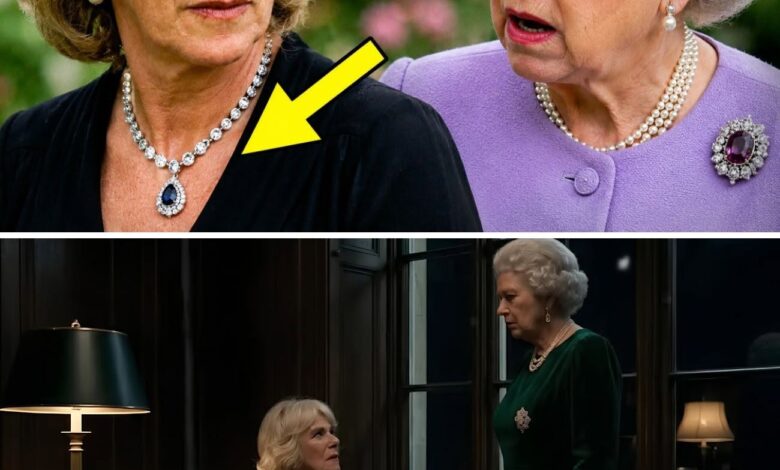
The Queen had spent a lifetime observing people. She paid attention not only to words but to silences, gestures, and the things others overlooked. That evening, while guests chatted about horses, weather, and country life, her eyes settled briefly on a necklace resting against Camilla’s throat.
To anyone else, it was unremarkable.
A delicate gold chain carried a small sapphire pendant no larger than a thumbnail. It was not a state jewel, not a famous royal heirloom, and certainly not the sort of piece that attracted public attention.
Yet the Queen recognised it instantly.
Years earlier, she had seen the same necklace worn by Diana, Princess of Wales, during a quiet family gathering. It had never been intended as a public symbol. It belonged to a chapter of family history that remained deeply personal.
The Queen said nothing.
She continued her meal, listened politely to conversation, and even smiled from time to time. But those who knew her well recognised the subtle change. She became quieter. More thoughtful. More still.
After dinner, guests moved into the drawing room. Coffee was served, chairs shifted, and small conversations formed around the fire.
Prince Charles stood speaking with guests while Camilla laughed gently at a remark from across the room.
The Queen exchanged a few words with those nearby before turning to one of her ladies-in-waiting.
“Would you ask Mrs Parker Bowles to remain for a moment after the others leave?” she said calmly.
There was nothing unusual in her tone, yet the message carried weight.
Camilla received the request with composure.
“Of course, Ma’am,” she replied.
As the evening drew to a close, guests departed one by one. Eventually only a few people remained. Prince Charles had just begun crossing the room when he was quietly informed that Her Majesty wished to speak with Camilla alone.
He stopped.
Not dramatically. Not long enough to attract attention. But long enough for those nearby to notice.
A few minutes later, Camilla entered a smaller sitting room.
The Queen stood near a window overlooking the darkness outside. Reflections from the room’s lamps shimmered faintly against the glass.
For a moment neither woman spoke.
Then the Queen gestured gently.
“Please sit down.”
Camilla obeyed.
The Queen remained standing.
“The necklace,” she said softly.
Almost instinctively, Camilla’s hand rose to her throat.
“Yes, Ma’am?”
“Where did it come from?”
There was a pause.
“Charles gave it to me.”
The Queen regarded her quietly.
“That was not my question.”
The words were calm, yet their meaning was unmistakable.
Camilla lowered her hand.
“He told me it had been put away for many years.”
“Did he tell you whose it was?”
Another pause followed.
“He said Diana wore it once.”
The room seemed suddenly smaller.
Camilla glanced away before meeting the Queen’s eyes again.
“I meant no disrespect.”
“No,” the Queen replied. “Disrespect within families is rarely about intention. More often, it is about permission.”
The words settled heavily between them.
The Queen moved slowly towards a small table and rested her fingertips lightly upon its polished surface.
“That necklace belonged to a very private part of someone’s life,” she said. “It carries memories that cannot simply be transferred because another person wishes them to be.”
Camilla listened without interruption.
“If I had fully understood—”
“But you understood enough,” the Queen answered gently.
There was no anger in her voice.
That made the conversation all the more difficult.
Anger fades. Disappointment lingers.
For several moments neither woman spoke.
Somewhere in the distance, a clock marked the quarter hour.
Then the Queen asked a question that immediately altered the atmosphere.
“Did William see it?”
Camilla hesitated.
“I don’t believe so.”
The Queen nodded slightly.
“You will leave the necklace here tonight.”
Camilla looked up.
“Ma’am?”
“In the Blue Room. With my dresser before you retire.”
The decision had already been made.
Camilla understood that.
“Yes, Ma’am.”
“Thank you.”
The conversation should have ended there.
Instead, it marked the beginning of another.
When Camilla left the room, Prince Charles was waiting further down the corridor. He had not been listening, but he knew enough to understand the outcome simply by looking at her expression.
A few minutes later, he entered the sitting room himself.
The Queen had resumed her place near the fireplace.
“You wished to see me?”
“Yes.”
Charles remained standing.
“This concerns the necklace?”
“Yes.”
He drew a measured breath.
“I imagine Camilla explained.”
“She explained enough.”
A silence followed, familiar to families who know each other too well to waste time on pretence.
“It was never intended to upset anyone,” Charles said.
The Queen looked directly at him.
“And yet you chose an object associated with the mother of your sons and placed it around the neck of the woman whose presence caused them considerable pain.”
Charles said nothing.
“If that surprises you,” the Queen continued, “then you have not been paying sufficient attention for a very long time.”
He turned slightly away.
“It was a private gift.”
“It was a memory,” the Queen replied, “and not yours alone.”
The words struck harder than anything said before.
For a moment, Charles stared quietly into the fire.
Finally he asked, “What would you like done?”
“The necklace will not be worn by Camilla again.”
He nodded once.
But the Queen was not finished.
“Tomorrow morning, you will speak with William.”
Charles looked up immediately.
“He never saw it.”
“Then you should be grateful.”
The Queen’s expression remained composed.
“You will speak with him anyway.”
“About what?”
“About the fact that some things cannot be moved from one life to another merely because it is convenient.”
The word convenient lingered in the air.
After a long silence, Charles spoke.
“You are making this larger than it is.”
The Queen shook her head slightly.
“No. I am simply reminding you that it was always larger than you believed.”
The conversation ended soon afterwards.
Yet throughout Windsor Castle, staff sensed that something had shifted.
Requests were made. Messages were delivered. A jewellery case was brought from storage.
Camilla retired early.
Charles remained awake longer than usual.
The Queen, as always, revealed almost nothing.
By the following morning, the necklace was no longer in Camilla’s possession.
Placed carefully inside a velvet case, it had been transferred to the royal jewellery custodian with instructions that it should not be reassigned without the Queen’s approval.
That decision surprised many.
A quiet correction had been expected.
Instead, the Queen removed the matter entirely from personal hands and returned it to the institution itself, where sentiment gave way to record, and record gave way to permanence.
At breakfast, Prince Charles appeared subdued.
Prince William was already seated at the table.
Prince Harry arrived shortly afterwards and quickly sensed an unusual atmosphere.
The Queen entered last.
She greeted everyone exactly as she always did.
Nothing in her manner suggested disagreement or tension.
Yet when Charles carefully asked whether he might speak privately with William later that morning, the Queen lowered her eyes towards her teacup.
“Yes,” she said. “I believe that would be wise.”
William glanced up only briefly.
It was enough.
The conversation between father and son took place before lunch behind closed doors.
No official account was ever recorded.
Those who saw William afterwards noticed only a subtle change.
He did not seem happier.
He did not seem calmer.
He simply appeared clearer, as though something important had finally been acknowledged.
Later, Harry asked what had happened.
“Nothing,” William replied.
Harry smiled faintly.
“That usually means something.”
William returned the smallest smile.
“It’s handled.”
Within royal circles, that single word could mean many things.
On this occasion, it meant enough.
That afternoon, Camilla appeared wearing pearls instead.
Simple. Elegant. Uncontroversial.
She was gracious towards the Queen.
The Queen was equally gracious in return.
To casual observers, nothing unusual had happened at all.
And that was precisely the point.
In royal life, the most significant corrections are often invisible.
There are no raised voices.
No public statements.
No dramatic confrontations.
Only a message delivered, a boundary restored, and an understanding quietly reaffirmed.
Years later, people would remember louder moments involving the Royal Family—interviews, headlines, departures, and public disputes.
Yet among those who understood what had happened that evening at Windsor, a different story endured.
It endured because the Queen recognised that certain objects carry more than monetary value.
They carry memory.
They carry sorrow.
They carry history.
And some things, once connected to profound personal pain, cannot simply be passed from one person to another as though they were ordinary gifts.
Without fanfare, without criticism, and without public spectacle, Queen Elizabeth II protected that distinction.
For those who witnessed it, that quiet act of judgment said more than any speech ever could.