Catherine’s Biggest Victory Yet! Duke of Kent Transfers the Romanov Sapphires as Camilla Is FURIOUS!

Catherine’s Biggest Victory Yet! Duke of Kent Transfers the Romanov Sapphires as Camilla Is FURIOUS!
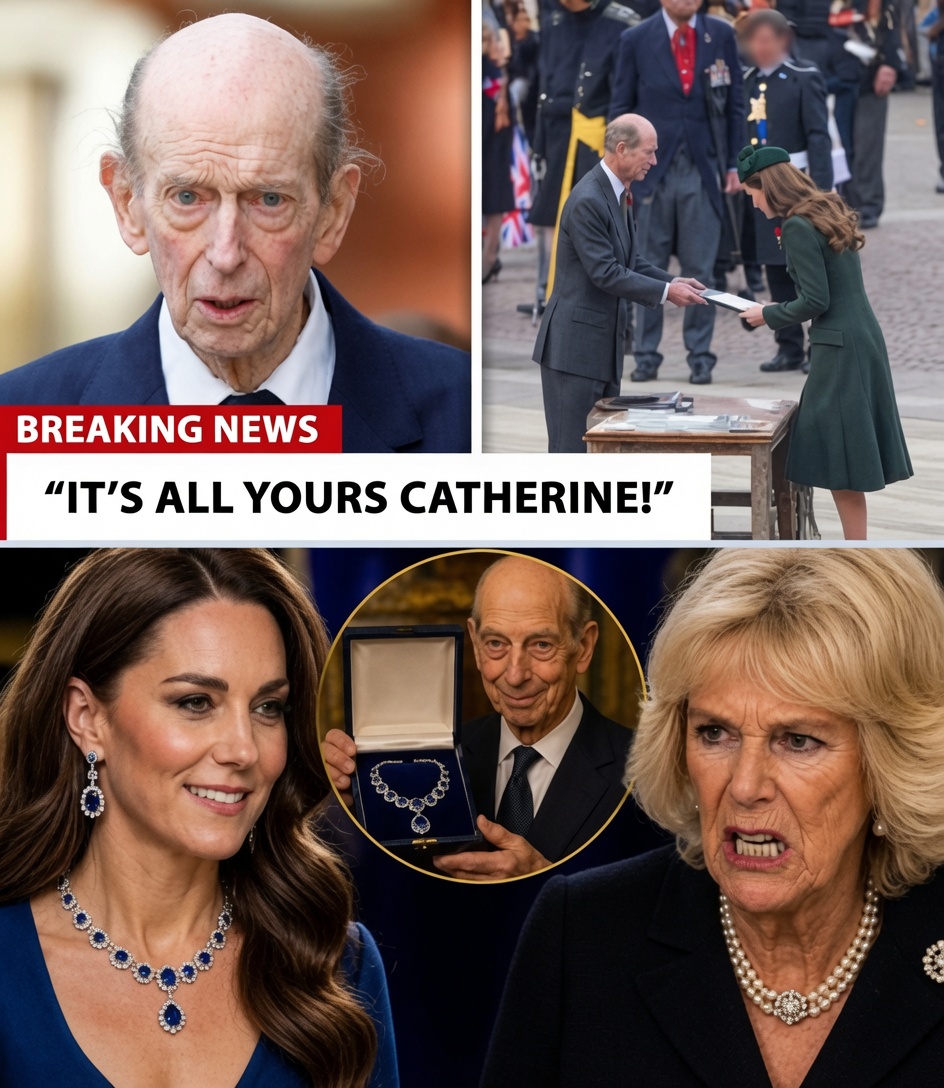
And the timing of the whole thing is fascinating because it lands exactly on Princess Charlotte’s 11th birthday and follows the death of the Duchess of Kent back in September 2025. Since his wife passed, the 90-year-old Duke has been laser-focused on the final disposition of his estate. And what he decided to do with these sapphires reveals a lot about who he actually trusts to carry the monarchy forward. And honestly, when you look at who he didn’t give them to, that’s where it gets really interesting.
So, let’s talk about what actually happened this morning. At 9:45, legal representatives for the Kent estate showed up at Windsor Castle to finalise the handover of what’s called the Cambridge sapphire parure. That’s the fancy term for a matching set of jewels. And this particular collection has been in the Kent family for over 90 years.
We’re talking about a tiara, a necklace, several brooches, and some earrings, though the full original set was bigger. Some pieces were sold off at Christie’s back in the ’70s when the family faced financial pressure, which is actually a key part of why this transfer is happening now. The Duke has firsthand experience watching historic jewels get scattered because they ended up with people who couldn’t afford to keep them. He didn’t want that to happen again. He carried that memory with him for decades, and it clearly shaped every decision he made about the remaining pieces.
Here’s what makes this transfer different from the usual shuffling of tiaras between royal households. These sapphires are not part of the Crown Jewels. They’re not held in trust for the nation. They are private property, which means they can be sold, gifted, or inherited at the owner’s discretion.
The King has no legal authority to demand they be surrendered to the royal collection. He cannot dictate where they go. This legal independence is the entire reason the Duke could make this move without needing anyone’s permission.
The stones originated with Princess Augusta, the Duchess of Cambridge, back in the early 19th century, then passed to Queen Mary, who gifted them to the Duke’s mother, Princess Marina, in 1934. Because they were a personal gift, they stayed private. They never entered the central royal vault system that the monarch controls. That distinction is everything. It means the Duke operated as a private citizen disposing of his own property, not as a royal functionary managing state assets.
The Duke’s decision to give these to Catherine instead of his own direct heirs tells you everything about how he views the future of the institution. His sons, George, the Earl of St Andrews, and Lord Nicholas Windsor, are non-working royals. They have their own lives, their own paths, and historically, when significant jewellery passes to family members without official duties, the items often end up at auction to cover inheritance taxes or just personal expenses.
The Duke watched pieces of the original Cambridge set get sold off decades ago, and he wasn’t about to let the remaining treasures go the same way. According to internal reports from the palace, he stated during a legal briefing last month:
“The stones must stay with the woman who represents the future of the monarchy, rather than being divided among private citizens who cannot wear them to state functions.”
That’s a pretty blunt assessment of his own children’s position, and it’s not coming from a place of animosity, it’s coming from a guy who has served the monarchy for over 80 years and views these objects as tools for public representation, not just pretty things to keep in a safe. He understands that jewellery at this level carries a diplomatic function, a symbolic weight that only activates when it’s worn in service of the Crown.
This is where the Duke of Kent’s personal authority really matters. He is one of only two members of the royal family who hold the rank of field marshal in the British Army, the other being the King himself. He inherited his dukedom at age six after his father died in a wartime aircraft crash in 1942, and he’s been performing royal engagements with absolute discretion for eight decades. He’s the longest-serving duke in British history.
When someone with that kind of resume makes a decision about his private estate, people pay attention. He reportedly told his estate executors that the rank he holds and the years he served are not for show, they’re tools to ensure that what his mother cherished remains within the working heart of the family, stating:
“I will not see these pieces scattered to the wind.”
That’s not sentimental language. That’s a man using every bit of institutional leverage he has to lock in a legacy, and he did it with the same quiet precision he brought to every military and ceremonial duty he ever performed.
The timing of all this traces back to the somber days following the Duchess of Kent’s funeral on September 16th, 2025. Observers noted several private meetings between the Duke and senior palace advisers during that period, and apparently that’s when the initial framework for the transfer began to take shape.
He was in a period of reflection, looking at what remained of his life’s work, and he decided that the preservation of the Kent legacy would be his final mission. The military-grade precision in his estate planning has effectively outmanoeuvred any potential efforts to centralise these sapphires under the Queen Consort’s patronage.
By utilising the legal protections afforded to private royal estates, the Duke ensured that his decision is final and binding. In the world of the Windsors, possession isn’t just nine-tenths of the law, it is the law itself. And the Duke understood that law better than almost anyone alive.
Now, a lot of people assume the relationship between Catherine and the Duke of Kent is just the standard distant cousin thing, maybe a few waves on the Buckingham Palace balcony. That assumption is wrong. If you dig into the official records from September 2020, you find that Catherine, then the Duchess of Cambridge, was appointed joint president of the Scout Association, serving alongside the Duke.
This was not a symbolic appointment. The Duke had held that presidency since 1975, and bringing Catherine in as joint president was a carefully orchestrated transition. Over the next six years, he watched her work ethic up close. He saw how she handled responsibility, how she respected the traditions of the past, and how she showed up for the quiet, steady service that has defined his entire career.
The Duke is a traditionalist who values duty above everything, and in Catherine, he apparently found someone he considered a kindred spirit capable of handling the weight of royal history without seeking the spotlight for personal gain. He saw someone who understood that service is not about the applause, but about showing up day after day, regardless of who is watching.
There’s also this linguistic and historical symmetry that I don’t think is accidental. The jewels in question are the Cambridge sapphires. For over a decade, Catherine carried the title of Duchess of Cambridge. To the Duke, the idea of these specific stones returning to a Duchess of Cambridge who actually performs the work of the monarchy must have felt like a restoration of the jewels to their rightful place.
His sons took different paths. George married a Roman Catholic, Nicholas converted to Catholicism, and while those are personal decisions they’re entitled to make, they historically complicated their positions within the traditional Anglican structures of the monarchy. More to the point, they’re private citizens. They don’t represent the King at state banquets, they don’t receive foreign dignitaries.
The Duke reportedly told his advisers that his sons chose their own journeys and he respects them for it, but added:
“These sapphires require a public life. They need to be seen at the heart of the nation’s ceremonies, not tucked away in a private safe or sold to settle an estate tax.”
Catherine, in his view, was the only one who could give them a purpose. She was the only one who could ensure they continued to do what they were always meant to do: appear on the world stage as symbols of continuity and grace.
That’s a pretty remarkable thing to say about someone who isn’t your child, but it also explains why this transfer creates such an interesting dynamic between the two most senior women in the royal family right now. Queen Camilla, as the Queen Consort, naturally has first right of refusal for the official Crown Jewels and many of the personal pieces left by the late Queen Elizabeth.
Her access to the legendary royal collection is unequalled. But those items are held in trust for the institution. They’re not hers personally in the same way these sapphires now belong to Catherine. The Duke’s collection operates under an entirely different set of rules. Because these items are private wealth, they bypass the traditional queue entirely.
The Duke exercised his legal right to look past the current occupant of the throne and place his treasures directly into the hands of the next generation. That creates a situation where Camilla represents the present, the steady hand at the side of King Charles during a period of transition, while Catherine is increasingly seen as the future, building a personal arsenal of history that belongs to her alone.
It’s not a competition in the personal sense, but it is a structural reality that shifts the centre of gravity within the family. Royal expert Katie Nicholl has often highlighted the strict hierarchy that governs the distribution of the late Queen’s jewellery. And normally that hierarchy would mean Camilla gets first look at anything significant, but the Duke of Kent’s private wealth doesn’t answer to that hierarchy.
The sentiment circulating among palace observers is essentially that the Queen has the crown, but the Princess has the momentum. Every time Catherine wears a piece with a story, she strengthens her bond with the public and reinforces her position as the ultimate ambassador for the family’s heritage.
The Duke’s decision ensures these specific sapphires won’t be absorbed into the vast anonymous inventory of the Crown. They’ll remain distinct, associated with the woman he believes will define the monarchy in the decades to come. That kind of clarity is rare in royal circles, where ambiguity and compromise usually rule the day.
And the thing that seems to have sealed this decision for the Duke was Catherine’s appearance on the Time 100 Health list in May 2025. To a 90-year-old man evaluating who deserves to carry a historic legacy, this recognition wasn’t just a nice honour. It was proof of something he needed to see.
The world watched throughout 2024 and early 2025 as Catherine navigated her cancer treatment and recovery. Her victory over that illness, documented by specialist outlets and mainstream publications alike, transformed her from a royal figure into a global symbol of resilience. By the start of 2026, independent polling indicated her approval rating had reached an unprecedented 90%. She had become in every measurable sense the most valuable asset to the House of Windsor.
For the Duke, a man who has spent eight decades observing the rise and fall of various royal reputations, this public mandate was crucial. His internal logic was reportedly that historic jewellery of this calibre must belong to the individual who holds the heart of the people. He viewed these sapphires not as fashion accessories, but as symbols of the monarchy’s enduring bond with the citizens it serves. And Catherine, through her grace under unimaginable pressure, had proven she was that bond in human form.
He reportedly told his executors during a private legal briefing last winter:
“Tradition is not about looking backward, it’s about ensuring that what is precious is held by those who can inspire the next generation. Catherine has shown a strength that goes beyond titles, and she has earned the right to wear these stones.”
That’s not the language of someone making a casual gift. That’s the language of someone making a calculated institutional investment.
And it culminated in a public moment on April 21st, 2026 during a ceremony marking the birthday of the late Queen Elizabeth. The Duke made what many believed to be his final significant public appearance, standing in quiet conversation with Catherine. Royal observers have since interpreted that scene as a symbolic passing of the torch. An elderly field marshal and the future Queen recognising something in each other. The photographs from that day show a particular kind of understanding passing between them, the kind that doesn’t require words.
So now we come to today, May 2nd, 2026, Princess Charlotte’s 11th birthday, and this is where the long game becomes visible. Catherine has been meticulously curating a private jewellery archive intended solely for Charlotte, a collection that stands independent of the official state vaults.
The confirmation of this transfer arrived with remarkable clarity this morning when Catherine was observed at a private family gathering at Windsor wearing the diamond and sapphire girandole earrings from the original Cambridge set. These pieces, once the pride of Princess Marina, were thought to be permanently retired from public view. Their reappearance today serves as a definitive signal that the Duke of Kent’s assets have successfully transitioned to the next generation.
This is no longer speculation, it’s a visible fact. And the choice to debut them on Charlotte’s birthday was not a coincidence. It was a message carefully calibrated that the line of succession for these treasures now runs directly through mother to daughter.
What this moment represents is the end of the Kent era as a major independent force in royal collecting and the beginning of a consolidated reign under William and Catherine. By securing these Romanov-descended sapphires, the Princess of Wales has ensured that the most vital pieces of the family’s private history remain within the direct line of the throne.
It’s a calculated act of preservation. A close family associate reportedly shared the sentiment that Catherine understands her daughter’s future status depends on the symbols of the past, and by securing the Kent legacy now, she’s building a foundation for Charlotte that cannot be touched by the shifting winds of palace politics.
That’s the key phrase here: cannot be touched. Because these are private assets, they’re not subject to the whims of whoever happens to be controlling the royal collection at any given moment. They belong to Catherine and one day they’ll belong to Charlotte, and there’s nothing anyone in the palace can do about it.
That kind of security is priceless in an institution where access to the royal vault can change with a single conversation behind closed doors.
The Duke of Kent, at 90 years old, has completed what he apparently views as his final duty. He navigated the complexities of inheritance taxes and royal protocols to place his family’s most treasured possessions in the safest possible hands. The handover is a testament to his trust in Catherine’s resilience and her role as a bedrock of the modern monarchy.
He didn’t choose the Crown, he didn’t choose the central vault, he chose a person and he chose her based on six years of working alongside her, watching how she handled pressure and ultimately seeing her emerge from a health crisis with more public support than ever.
That kind of clarity of vision is rare at any age, but at 90, it speaks to a lifetime of learning how to read people and how to measure character. The Duke trusted his own judgement over every protocol and every expectation and he acted accordingly.
The image of those sapphires at Windsor today is the most powerful piece of evidence we have. They represent the bridge between the 19th-century grandeur of Queen Mary and the 21st-century reality of a monarchy that is slimming down but becoming more focused.
The centralisation of these treasures under Catherine ensures they will continue to be seen at the most significant moments of national life, rather than disappearing into the obscurity of a private estate or being broken down for their raw materials.
The Duke has seen too many royal treasures vanish into private collections. He wasn’t going to let it happen again on his watch, and by acting now while he still has the legal capacity and the moral authority to direct his estate, he has closed the door on any future ambiguity. The sapphires are where they belong, and that chapter is finished.
When you step back and look at the whole picture, the story of the British monarchy is often told through its battles and its laws, but its true endurance is found in these tangible links of gold and stone. History isn’t just written in ink, it’s etched into the Romanov diamonds and Cambridge sapphires worn by the woman who will one day be Queen.
Catherine hasn’t just acquired a collection, she’s secured a future, and she’s done it with the blessing of the one man whose private wealth and military rank gave him the authority to make it happen without asking anyone’s permission.
The Duke of Kent spent 80 years serving an institution that often moves slowly and cautiously, but in his final act he moved decisively. He looked at the family tree, looked at who actually shows up, looked at who the public trusts, and placed his legacy in the hands of the person he believes will carry it forward. That’s not just a gift, that’s a verdict, and it’s a verdict that will echo through every state banquet, every diplomatic reception, and every historic photograph for the next 50 years.