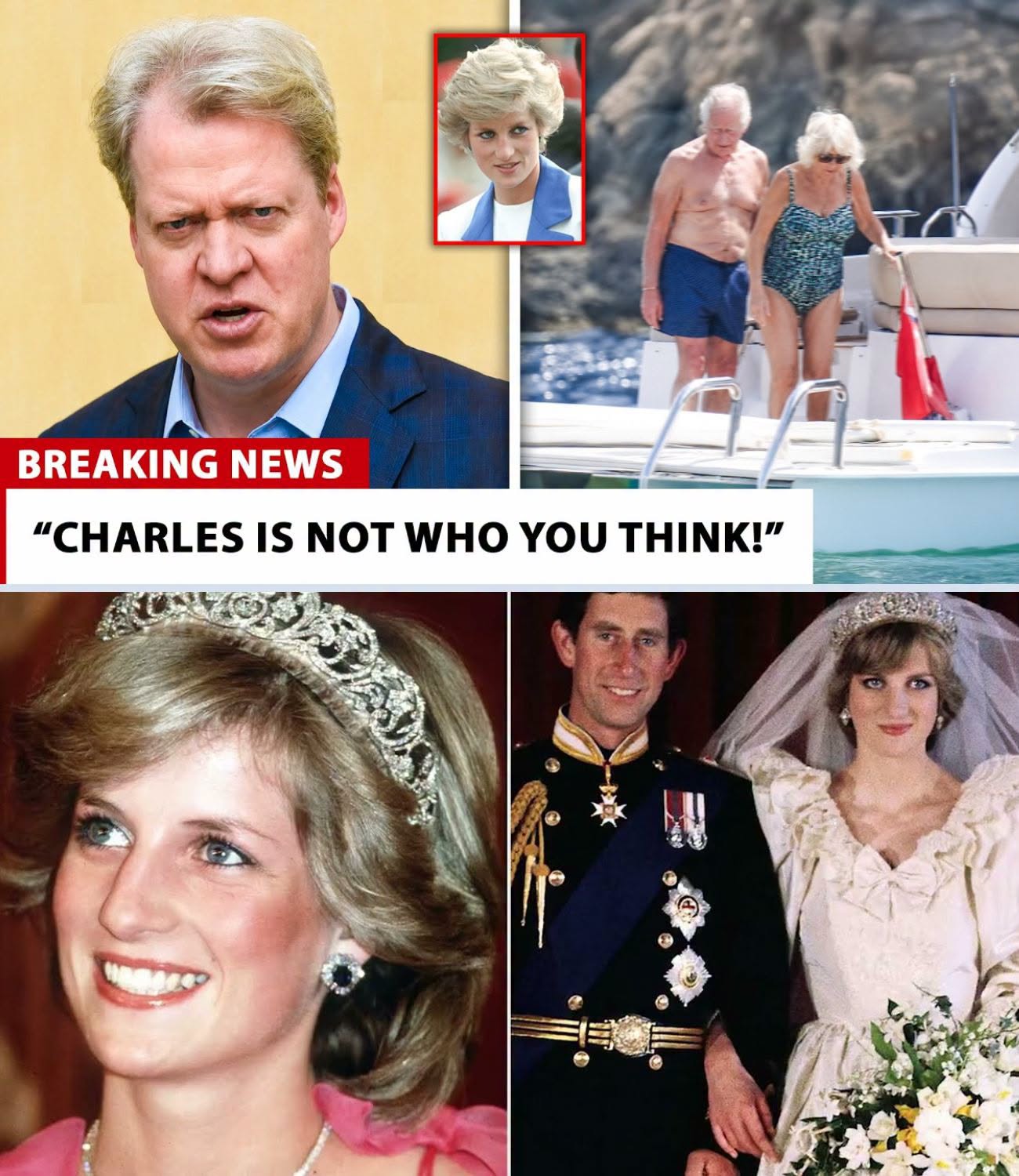
Princess Diana’s Brother SHOCKS The World With STUNNING Revelations About His Sister!
So Charles Spencer sat down and basically confirmed what a lot of people have suspected for years. And the thing that gets me is how one specific lie completely changed what happened at that funeral. Like we’ve all seen the image. It’s burned into pop culture history. Two boys, 15 and 12 years old, walking behind their mother’s coffin in front of billions of people.
Prince William with his head down. Prince Harry looking so small. And the whole world watching them, analysing their faces, waiting for a tear, waiting for a crack. It’s been held up as this picture of British stoicism and duty. But when you actually listen to what Charles Spencer is now saying, the entire foundation of why those boys were there was built on something that wasn’t true. And honestly, the fact that they won’t just answer the question is the weird part.
What Charles Spencer is revealing now isn’t just sad, it’s infuriating because it hinges on a manipulation. The image of that procession didn’t just happen. It was a decision made in a boardroom. And Charles Spencer, Diana’s younger brother, was the only one in the room who apparently had the instinct to scream at the top of his lungs:
“Absolutely not!”
He’s been talking about what happened in the days between Diana’s death and the funeral. And the timeline of how that procession came together makes absolutely no sense if you look at it through the lens of protecting children. Spencer says he was on the phone with a Buckingham Palace courtier deep in the logistics of the burial committee when the plan to have Prince William and Prince Harry walk behind the coffin was just dropped into the conversation casually, as if it was a normal, sensible thing to suggest.
Spencer’s reaction, according to him, was instant. He told them:
“No. Diana would have never, ever wanted her sons to do this.”
It wasn’t a polite disagreement. It was a firm, visceral refusal. He saw it for exactly what it was: a parade of grief-stricken children for the cameras. He argued that it was profoundly unnatural and cruel to force two boys, fresh in the rawest trauma of their lives, to march in a straight line while millions of people wept at them.
When you actually look at what was said versus what happened, this is where the story takes a turn that makes my stomach hurt. The palace’s response to Spencer’s protests was ice cold.
“It has been decided.”
That’s the phrase that came back. Not a negotiation, not a discussion about trauma-informed care, just a declaration.
Spencer didn’t back down easily. He kept pushing, demanding they reconsider the psychological damage this would do. He knew his sister. He knew the pressure of the institution, and he knew that putting a 12-year-old through a state funeral march was a recipe for decades of therapy. But then, at some point in the back and forth, the door slammed shut on his argument. He was told:
“Prince William and Prince Harry themselves want to do it.”
That changed the math for Charles Spencer completely. If his nephews, despite their age, had made the conscious choice to say goodbye to their mother in this public, agonising way, who was he to stand in their way? He didn’t want to force them into something they didn’t want, but by the same token, he respected their autonomy enough to step aside if this was truly their wish. So, he dropped it.
He let the matter go, believing he was honouring their decision. The problem, which we now know thanks to Prince Harry’s own words, is that they were never given a choice. Not even close. Harry has admitted that as a 12-year-old, you don’t get a vote in a room full of senior royals and courtiers. You are told what to do. You are put in a suit and you walk. That’s it.
So that’s where it gets weird. Charles Spencer was effectively neutralised by a lie. He was the one person with the power and the fury to stop that grotesque spectacle. And he was told a story that made him stand down. If that’s true, then this makes no sense as a duty narrative. It makes sense as a calculated move to control the optics of the day, regardless of the human cost.
The morning of September 6th, 1997, was heavy in a way that’s hard to describe. The air in London felt thick, and the streets were a river of flowers, handwritten notes, and grown adults sobbing so hard they could barely stand.
And then the coffin appears, and behind it, Charles Spencer is walking alongside Prince Charles and Prince Philip. But everyone’s eyes, every camera lens is locked onto the two small figures in front of them. Prince William at 15 trying to look composed, and Prince Harry at 12 looking completely hollow.
Spencer has said that while the world watched them and saw bravery, he looked at them and saw two children burdened with a duty they should never have been given. The walk from Kensington Palace to Westminster Abbey is a long, brutal distance. The sound of the crowd’s grief was apparently deafening, a constant thunder of crying, but the boys never broke.
Harry later described a feeling of numbness, as if his emotions had completely shut down, like he was watching a movie of someone else’s life. For Charles Spencer, the pain of that day wasn’t just about losing his sister, who he genuinely adored. It was the agony of realising he had lost the battle to protect her sons from this moment. He had been tricked into compliance, and now all he could do was walk beside them while they suffered in real time.
But what Charles Spencer did next when he stood up at the pulpit left everyone speechless in a completely different way. He took the microphone inside Westminster Abbey and he didn’t just deliver a eulogy. He drew a line in the sand that the royal family is probably still trying to scrub out.
Standing at that podium, Charles Spencer didn’t speak about Diana in the past tense. He spoke for her in the present. He described her as the most hunted person of the modern age. And he didn’t just blame the paparazzi. He blamed the institutions and the structures that failed to protect her.
The royal family was sitting right there. The Queen, stone-faced. Prince Charles, showing zero reaction. And Spencer’s words were cutting right through the abbey. He made a promise that made headlines around the world. He promised that Diana’s blood family, the Spencers, not the Windsors, would always be there to protect and guide Prince William and Prince Harry.
It was a direct, undeniable challenge to the royal family’s authority. He was essentially telling the monarchy in their own church, on their own turf, that they weren’t good enough to raise these boys alone.
The response was something you practically never see at a royal event. Applause.
It started outside, rippling through the crowds listening on speakers, and then it crept into the abbey. Dignitaries, celebrities, people in the pews started clapping. It was a spontaneous, defiant roar of agreement. Spencer had articulated what a grieving, furious public felt. Diana had been wronged, and someone was finally brave enough to say it out loud in the most official setting possible.
Sadly, Charles Spencer would later admit that keeping that promise was functionally impossible. As powerful as his words were, Prince William and Prince Harry were already hardwired into the royal system. There was no legal mechanism for him to just extract them and raise them in the way Diana might have imagined. The monarchy controlled their future, their education, their public roles, and their narrative, and he could do nothing about it.
But to understand the fury in that eulogy, you have to rewind to the moment Charles Spencer first got the phone call, because the way the royal family handled the immediate aftermath is a masterclass in emotional disconnect.
The crash happened in a Paris tunnel in the early hours of August 31st. A Mercedes tried to outrun photographers, crumpled like a tin can. Diana was alive, but barely.
Miles away in South Africa, Charles Spencer was asleep when the phone rang. The first call was the warning:
“There’s been an accident.”
He sat up, mind racing, knowing immediately that the press had finally pushed too far. He waited, heart pounding, for an hour. Then the second call came, and the voice was different. Cold.
“I’m sorry, sir. She didn’t make it.”
He knew exactly who to blame. The paparazzi who had hounded her for years. But there was no time to grieve. The world was about to find out. And the reaction of the royal family is where the disconnect became a chasm.
When the news hit, the public reaction was immediate and visceral. People poured into the streets, sobbing, collapsing, burying their faces in their hands. Outside Buckingham Palace and Kensington Palace, flowers piled up by the thousands. It wasn’t just mourning. It was a collective scream of heartbreak. But something strange was happening at the top. The royal family was completely, utterly silent for hours, then days.
No public statement, no national address, no sign that they were mourning with the people. They remained at Balmoral Castle in Scotland, hidden from view. At first, people assumed they were in shock, but as the days dragged on, the silence started to feel like indifference. The questions started getting louder:
“Why isn’t the Queen saying anything?”
“Why isn’t the flag at Buckingham Palace lowered to half-mast?”
“Why aren’t Prince Charles and the boys in London?”
The newspapers, usually so deferential to the monarchy, turned on them. The headlines screamed:
“Betrayal. Where is our Queen? Where is our flag?”
The British public felt abandoned. This was Diana, the People’s Princess. And the monarchy looked like it didn’t know what to do, or worse, didn’t care.
While the world demanded answers, Prince William and Prince Harry were suffering in silence inside Balmoral. Prince Charles had to sit them down and explain that their mother had died in a car crash. She wasn’t coming back. Harry, just 12, kept asking the same question over and over:
“Is she really gone?”
They had spoken to her on the phone the day before. It was a quick, casual conversation. A “call you later” moment that now felt like a cosmic unfairness.
In those first few days, they were kept from the public eye, surrounded by a family not exactly known for outward displays of emotion. Harry later admitted he felt confused. The whole world was crying, but inside the palace, there was just a stifling silence. No one talked about Diana. No one comforted them the way they needed.
The pressure on the royal family eventually became a crisis. The outrage was too loud to ignore. On September 5th, 5 days after Diana’s death, the Queen finally addressed the nation. Sitting in front of cameras, she spoke of a remarkable human being and praised Diana as a loving mother. She said she understood the people’s grief and that they had lost someone irreplaceable.
But for many, it was too late. The damage had been done. The monarchy had looked out of touch, cold, and distant at a time when warmth was needed most. Diana’s death revealed a gap between the institution and the people it was meant to serve. Even after the Queen’s speech, the resentment lingered because the difference between Diana and the royals had never been clearer. She was open and human. They seemed untouchable and removed. And now, in the wake of her death, that divide was a canyon.
This brings us back to the funeral and that decision to make the boys walk. Charles Spencer never stayed silent about what he saw as the royal family’s failure, not just in Diana’s life, but in her death. From the moment she married Prince Charles, he believed she was thrown into a system that didn’t protect her. And even after she died, that same system continued to fail her.
Charles Spencer’s criticism of the royal family is the thread that ties this whole tragedy together. He never sugarcoated the truth because, for him, Diana’s story wasn’t just about a tragic accident. It was about an injustice that started years before that tunnel in Paris.
He repeatedly said that Diana was never truly accepted by the royal family. She went from being a 19-year-old girl full of life to a woman trapped in a cold, rigid system. She was expected to smile, follow the rules, and ignore her pain. And when her marriage to Prince Charles fell apart so publicly, she was pushed further away.
Spencer was furious about this. He made it clear in multiple interviews that they knew the press was hunting her. They knew she had lost her proper security detail after the divorce. And yet they did nothing. The result was a woman who was constantly running. On August 31st, 1997, that running finally caught up with her.
His eulogy was the climax of that anger. He stated clearly:
“Diana needed no royal title to continue to generate her particular brand of magic.”
It was a bold statement. In other words, Diana’s power had never come from the monarchy. It had come from her. She didn’t need them. They needed her. But Spencer’s final statement was what really shook the room. He promised that her sons would be protected from the same fate, saying:
“Their blood family would do all they could to continue the imaginative and loving way the royal family was steering these exceptional young men.”
The sarcasm was dripping. He was making it clear:
“You failed Diana, but we won’t let you forget her sons.”
Spencer never softened his words. In later interviews, he described the royal family’s treatment of Diana as inhumane. She had been used when they needed a bride and a mother for an heir, and discarded when she became too popular, too independent, too difficult. He revealed that she had turned to him in deep distress, calling him crying, telling him:
“I am so lonely. I feel so trapped. No one is listening.”
…and nothing changed. His criticism remains one of the most honest, raw accounts of Diana’s life behind palace walls. He didn’t just blame the institution; he blamed specific people. He believed those within the palace wanted Diana to be broken. They didn’t like how much attention she took away from the rest of the family. In one interview, he said:
“Diana was the most hunted person of the modern age.”
And she was left to face that hunt alone. Even after Diana died, Spencer believed the royal family failed her again with the handling of the funeral. He fought against the procession, arguing:
“The boys are too young.”
But his protest didn’t matter. The decision was made, and years later, Prince Harry himself admitted it had traumatised him. Spencer had been right, but once again, the royal family hadn’t listened. And this is where the story doesn’t end, because it lives on through her sons, especially Prince Harry.
Charles Spencer had spent years speaking out about how the institution failed Diana. But in the end, Prince Harry would take action. He would walk away, refusing to let history repeat itself.
From the time he was a child, Prince Harry was compared to his mother. He had her rebellious streak, her warmth, and most of all, her deep discomfort with the royal system. He never forgot how she was treated. He remembered the press hounding her, the way she was left to struggle alone, and most painfully, how she was gone in an instant, chased to her death by the very media she had spent years trying to escape.
That trauma shaped him. In interviews, he later admitted that every time he saw paparazzi cameras flashing, it took him back to that night in 1997. He saw history repeating itself, not just with himself, but with Meghan Markle. That was the moment he did something that shook the whole royal family. He left.
He saw Meghan facing the same treatment Diana had endured. The negative headlines, the attacks from within the palace, the lack of support. And just like Diana, Meghan was struggling. He refused to let it happen again. In one of his most emotional interviews, he said:
“I saw history repeating itself and was helpless to stop it.”
But unlike Diana, he could escape. And so in 2020, Prince Harry and Meghan Markle made the shocking decision to leave the royal family. They moved to the US, cutting official ties with the institution that had defined their lives. It was the boldest move any royal had made in modern history.
But for Prince Harry, it wasn’t rebellion. It was survival. Even in his departure, Prince Harry was following his mother’s path. Diana had tried to break free in the years before she died. She had distanced herself from the monarchy, found a new life outside royal duties, and started speaking out about her struggles. She was redefining what a royal could be. Prince Harry was now finishing what she started.
And Charles Spencer, the man who had fought so hard to defend his sister’s legacy, quietly understood. While he didn’t make huge public statements, it was clear that he understood why Prince Harry left. After all, he had spent decades criticising the same system Prince Harry was now rejecting.
The whole thing is a brutal full-circle tragedy. Charles Spencer stood up in that church and promised to protect Diana’s boys from the machine that consumed her. He was blocked at every turn, deceived about their wishes, and forced to watch them march in a funeral that traumatised them. Now, decades later, one of those boys has physically removed himself from the machine entirely.
The promise Charles Spencer made couldn’t be kept within the walls of the palace, but it seems like for Prince Harry at least, it was kept by leaving those walls behind completely. It’s not a victory. It’s just a sad, inevitable conclusion to a story that started with a lie about a walk behind a coffin.
And honestly, the fact that they won’t just answer the question of who really made that call is the weird part of all of this.