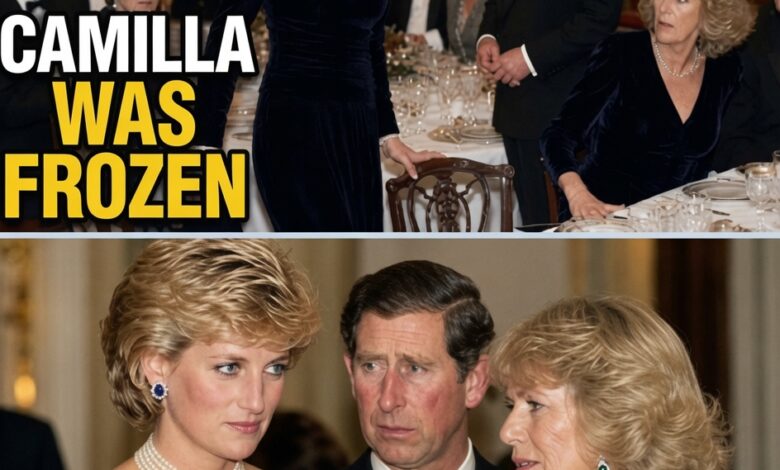
Diana Left the Royal Table Without Saying a Word — What She Did Next Humiliated Camilla
Behind her is the most beautiful monument ever built by a man for the woman he loved. And in front of the camera, a woman whose husband didn’t bother to show up. She sat there for 5 minutes and didn’t say a single word. When a journalist asked her what she thought of the Taj Mahal, Diana replied with two words:
“Very healing.”
And when they asked her to say more, she smiled and said:
“Work it out for yourself.”
That photograph swept across every magazine cover in the world, not because Diana had said anything, but because she didn’t need to say a word. The empty space next to her spoke louder than any press statement, any palace communique, or any interview. And what almost no one remembers today is that 12 years earlier in 1980, Charles had visited the Taj Mahal when he was still a bachelor.
He was with his photographer, Kent Gavin. Standing in front of the monument, Charles said something that Gavin never forgot:
“Someday, because this monument is about a man who loved this woman so much that he built this for her, I am going to bring my wife here.”
He didn’t bring her. He went to a business meeting in Bangalore, and Diana went to the Taj Mahal alone.
This bench, this empty space next to Diana, is the heart of this story. Because every time Diana left a royal table quietly, what she did next became the cover story no one expected. And every cover, one by one, built something that Camilla Parker Bowles has not been able to undo in 30 years.
Before this story ends, you will understand the five times Diana got up from a table without saying a word, and how each of her silences was more devastating than any speech. From a party in Richmond to a gallery in Kensington, from a marble bench in India to a television studio in her own home. Every time Diana chose to leave, what came next changed everything.
And if you remember those years, if you saw the covers, if you followed the story, if you cried that August night, then you know this story hasn’t ended. Because 30 years after her death, Diana remains more beloved than the woman who married her husband. And that is the humiliation that no one can repair.
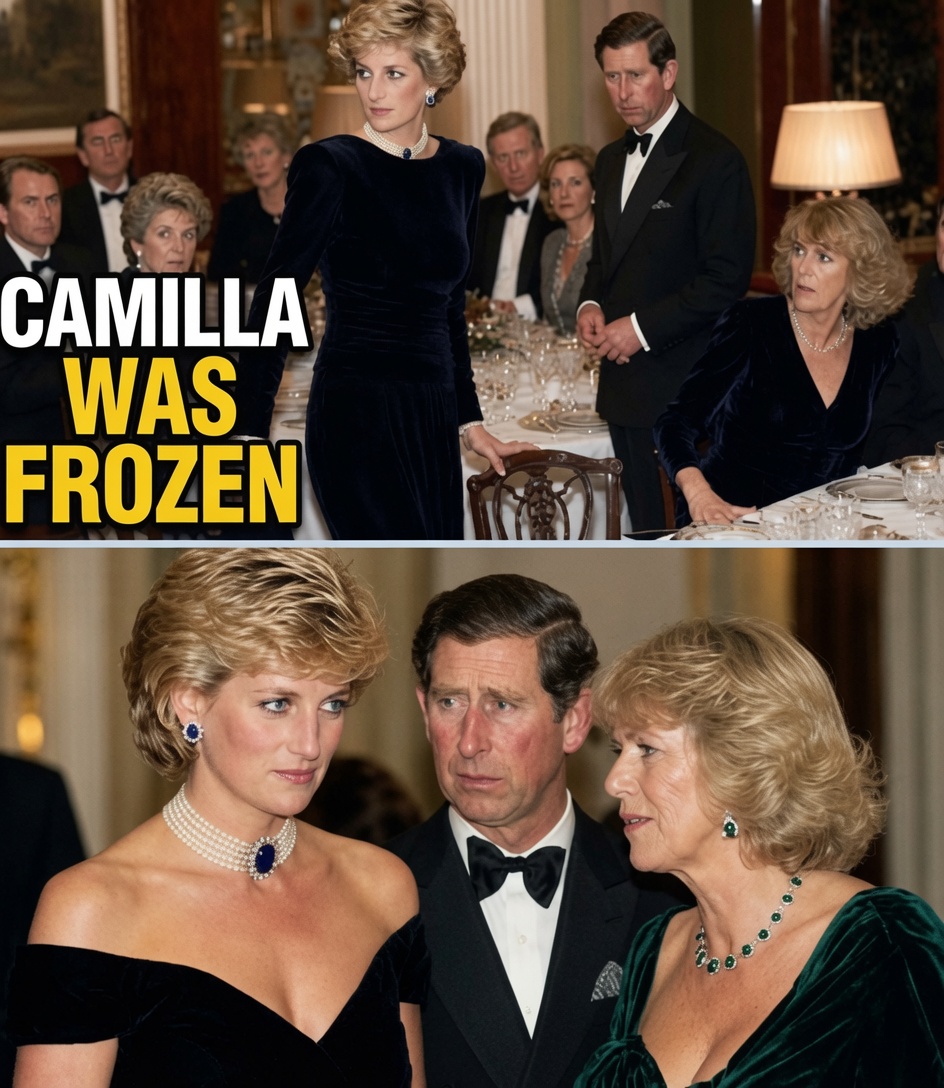
Think of a house party in Richmond, February 1989, the 40th birthday of Camilla’s sister at the estate of Lady Annabel Goldsmith. Diana did not belong to that circle. No one had put her on the list of people who fit in here. Her bodyguard, Ken Wharfe, would later recount that seeing her walk in was as if someone had paused a movie.
Everyone froze for a second, surprised that she had dared to show up. But she didn’t arrive by chance. According to what she confessed years later for Andrew Morton’s book, something inside her had told her that night to go prepared for anything. She walked through the door, shook Camilla’s hand instead of giving the protocol-mandated kiss, sat down, ate, and smiled where she was supposed to smile.
She played the model guest for an hour and a half. And then she noticed the void, two empty chairs, those of her husband and the hostess of her private humiliation. She stood up. Someone tried to stop her. A whisper of ‘don’t go down there’ floated in the air. It didn’t work. She went straight to Wharfe:
“Come with me. I can’t find my husband or Camilla.”
He himself later admitted there was no way to refuse. The pain on her face was undeniable. They went down together. And there the two of them were, comfortably sitting on a basement sofa, as if nothing were happening. Diana didn’t scream. She simply looked at Camilla and delivered a line that Wharfe would describe as an act of pure courage:
“Don’t treat me like an idiot. I know exactly what is going on.”
Camilla’s response was, according to the bodyguard himself, something he never fully understood. But that wasn’t what mattered. What mattered was that, for the first time, someone else besides her had heard the truth spoken out loud, face-to-face, without palace intermediaries.
Biographer Ingrid Seward described that night as devastating for Diana’s mental clarity. She cried the entire way back, and in that car, between Charles and her, there was not a single word. The silence of the journey back contrasted with the noise she had made going down those stairs.
From that night on, something changed irreversibly. There was now a witness who could not be silenced, someone employed by the Crown who had seen with his own eyes what the palace insisted on denying. The lie began to crumble that very night, in a basement, without cameras, without journalists, with only three people and the truth hanging in the air.
Now imagine a white marble building raised by an emperor who lost his wife and decided to immortalise her in stone for all eternity. That is the setting for the second scene, and this time there was no confrontation, no shouting, only a woman sitting in absolute silence.
February 1992, official tour of India. Charles and Diana were travelling together on paper, but each carried their own agenda, like two satellites orbiting the same planet without ever touching. He had business commitments in Bangalore. She wanted to see the Taj Mahal, something she had never seen.
Everyone assumed the couple would pose together in front of the monument. It was the photograph the press expected, the image that protocol demanded. But Charles chose the meetings and let Diana travel alone to Agra. Photographer Kent Gavin, who 12 years earlier had heard Charles promise that he would one day bring his wife there, was present once again, this time to capture the breaking of that promise.
That image said absolutely everything about the real state of things, he would later confess. Diana remained at the site for an entire hour. She sat on the bench for 5 minutes in a silence that weighed heavier than any statement. To her guide, Professor Mukund Rowat, she confessed in a whisper:
“It would have been much better if the two of us had come together, but my husband had to stay in Delhi.”
When journalists cornered her, begging for a quote for their headlines, she handed them a sentence wrapped in courtesy and edge:
“It was very healing.”
And when pressed:
“Work it out for yourself.”
That photograph struck the monarchy like never before. A woman alone in front of the temple dedicated to eternal love, a seat designed for two occupied by only one. The emptiness next to her screamed with a force that no royal communiqué could suppress.
There were no direct accusations, no names mentioned, not a single word about infidelity was necessary. The image was enough on its own. The cost to Camilla was enormous, though invisible at the time. From that day on, public sympathy for Diana became impossible to reverse. It was an image so sharp, so symbolic, that no one could continue to support the palace narrative that she was exaggerating or unbalanced, the label the Queen Mother herself had used in private.
That photograph shattered the official narrative in a single blow. Three months later, Andrew Morton’s book was released, telling her story in her own voice. Shortly after, the formal announcement of their separation came.
And there is a final twist. In 2016, 24 years later, William and Kate posed together on that very same bench. They filled the gap that Diana had left empty, but no matter how hard they tried, the original image could not be repaired, because anyone who remembered that previous photo knew exactly who had sat there first, completely alone, with only 5 minutes of silence and a sentence of just four words that held all the truth in the world.
Let us move to London, June 29th, 1994. That night, millions of Britons turned on their televisions to watch the documentary Charles had granted to ITV, an extensive two and a half hour interview conducted by Jonathan Dimbleby.
At a certain point, Dimbleby asked him bluntly if he had been faithful during his marriage. Charles replied that he had until the relationship was irretrievably broken after both had made a sincere effort. It was the first time a future king publicly admitted to adultery. 23 million viewers heard it live.
Diana had two paths before her. Stay at home as expected of a discreet wife, turn off the television, or leave it on without comment, wash her hair, and go to sleep. That was the traditional script, the one all the women of the crown had followed before her. But, Diana decided to rip it up.
She had previously declined an invitation to a Vanity Fair gala at the Serpentine Gallery inside Kensington Gardens. However, 2 days before the event, when previews of the documentary made it clear what Charles was going to confess, she changed her mind and confirmed her attendance. She didn’t just choose to go out, she chose the armour she would wear to do so.
In her wardrobe, she had kept a black off-the-shoulder silk dress with a plunging neckline and an asymmetrical cut designed by Christina Stambolian for 3 years. She had bought it for 900 pounds in 1991 and had never dared to wear it, considering it too revealing.
Her butler, Paul Burrell, recounted the scene that afternoon. Diana hesitated, saying she couldn’t face the world that night, and that she had nothing appropriate to wear. Burrell showed her the stored dress. She looked at it and asked if it wouldn’t be too much. Then, the final decision:
“Let’s go, Paul.”
He zipped it up. She looked at herself in the mirror, and she left the house.
Julia Peyton Jones, director of the gallery, recalled that when Diana stepped out of the car, it was impossible not to gasp. Lord Palumbo described her walk as athletic and determined. Photographer Tim Graham estimated that from the moment the car door opened until she crossed the threshold of the gallery, barely 30 seconds passed.
That half minute became the most repeated image of 1994. The dress’s designer herself, Stambolian, made a telling observation. Diana did not choose to project herself as the innocent victim dressed in white, but rather as the dark fierce version of that same story, borrowing the classical ballet duality of the white swan and the black swan. She decided to be the black swan that night.
The next day’s headlines spoke of the woman who had eclipsed her husband just as he was trying to justify his affair. One newspaper described her flatly as the absolute star of the night, overshadowing Charles’s confession.
Author Georgina Howell was even more direct in her book on Diana’s fashion, calling the dress perhaps the most strategically used piece of clothing in recent history, capable of stealing all the headlines from her own husband in a matter of seconds. Royal commentator Richard Fitzwilliams summarised it with a phrase that became a standard reference. That dress was a silent triumph, a dramatic way of communicating exactly how she felt without words, instantly winning the public’s empathy.
Charles, on the other hand, did not understand the rules of the media game. The only thing people remembered from his interview was his confession of adultery, an absolute public relations disaster. For Camilla, the cost was even higher. Her identity was publicly sealed as the other woman, and the national conversation stopped revolving around Charles’s confession, and focused entirely on Diana and her choice of clothing.
Camilla became merely a footnote to the story of the woman her lover had hurt. The Taj Mahal bench was a silence. This dress was a lightning bolt, but the mechanism was identical. Diana abandoned the table others had set for her and sat at her own, forcing the entire world to look where she chose to be.
Let us fast forward to November 20th, 1995, in the private drawing room of Diana’s apartment at Kensington Palace. Under the pretext of installing sound equipment, a camera was hidden. BBC journalist Martin Bashir had secured the interview using forged documents, a fraud that would only come to light many years later.
Diana sat in front of the lens, ready to violate the most sacred rule of the institution. Never speak out, never complain, never explain. That night, she spoke.
23 million viewers in the United Kingdom alone, 200 million across the planet. The national grid detected a thousand megawatt spike just as the broadcast ended. All of Great Britain put the kettle on to make tea at the exact same time, processing what they had just witnessed. Diana looked directly into the camera and delivered the phrase that would define an era:
“There were three of us in this marriage, so it was a bit crowded.”
13 words that collapsed three decades of a monarchy determined to keep private matters private, but she didn’t stop there. She spoke openly about her bulimia, her depression, the time she self-harmed, and how the institution had reacted when she asked for help. She recounted that she was probably the first person in that family to go through a depression or to cry without hiding, and that the immediate response was to label her unstable, mentally unbalanced.
At the close, Bashir asked her if she would one day become queen. She smiled slightly and answered with the phrase that would accompany her forever. She would like to be a queen of people’s hearts rather than the queen of a country.
Camilla’s reaction to that interview was documented by biographer Tom Bower. She called her, without filter, a mad cow, and argued that Diana had little moral authority to complain about her affair, implying that Diana herself had had numerous affairs. Diana, for her part, already had a nickname reserved for Camilla. Confessed to her friend Simone Simmons, she called her the Rottweiler because in her own words, she looked like a dog and once she bit, she never let go.
The price of that interview for Camilla was measurable with statistical precision. In 1997, the year of Diana’s death, a YouGov poll revealed that 57% of Britons had an unfavourable view of her. She had become the most unpopular woman in the country, a shadow that three decades later has still not completely faded. Four scenes, four silences turned into global headlines, and there remained a fifth, the quietest of all, and also the most powerful.
On August 28th, 1996, the divorce was finalised. Diana lost the style of Her Royal Highness. In exchange, she received 17 million pounds, an annual allowance close to 350,000, kept her residence in Kensington, and shared custody of her children. She walked away from the royal table for good. But what was truly significant happened after that signing.
In January 1997, wearing a bulletproof vest and a protective visor, she walked through a cleared landmine field in Angola. She sat with survivors who had lost limbs. She hugged children amputated by explosives buried years before.
Those images travelled the globe while Camilla remained completely off the public radar, not by her own choice, but because Diana absorbed every shred of available media attention. Diana was reinventing from scratch what it meant to be royal.
She no longer needed a formal title to capture global attention. She only needed to choose uncomfortable causes, subjects that no member of the institution wanted to touch, landmines that Western governments continued to sell, AIDS patients rejected by stigma, terminally ill patients whom society preferred to ignore.
In June of that same year, she auctioned 79 of her evening gowns at Christie’s in New York, raising more than 3 million dollars for the Royal Marsden Hospital and an AIDS charity. Her quote for the occasion remained engraved in collective memory:
“The sequins can save lives.”
Vanity Fair described the event as a powerful symbol of personal transformation. She was stripping away a life that at its core had never been authentic. She got up from the last royal table, sold the wardrobe of the role she no longer wanted to play, and went to walk across landmine fields.
The cost of that final scene for Camilla was definitive. While Diana toured Angola, hugged the sick, and auctioned her wardrobe for charitable causes, Camilla remained, in the eyes of the public, solely the woman for whom a royal marriage had been destroyed. With no cause of her own, no favourable headlines, and no identity beyond the shadow Diana cast over her. And when Diana died on August 31, 1997, that shadow did not dissipate. On the contrary, it became permanent.
Ken Wharfe witnessed Diana’s first departure that night at Lady Annabel Goldsmith’s estate. He would later recount that after that confrontation in the basement, he noticed a different woman, firmer, more confident. He also said something revealing. It was as if she had lifted a weight she had carried since the first day of her marriage.
Wharfe understood, before anyone else, the pattern that would repeat itself. Every abandoned table strengthened her, and every time another person occupied the chair she left empty, they discovered that the chair no longer held any value. What really mattered was the destination Diana was heading towards next.
Kent Gavin was the one who captured her image on that bench in front of the Taj Mahal. He himself had witnessed Charles’s promise 12 years earlier, as well as the day that promise was broken forever. His conclusion was simple. The photograph explained everything without the need to add words.
Richard Fitzwilliams, with decades of analysing the royal family, synthesised the night of the dress with a phrase that has become inescapable. Charles never understood the rules of public communication. His confession of infidelity was all people retained from that interview, and for him, it represented a total image disaster.
That idea explains the entire pattern of Diana’s behaviour. She understood something the institution never managed to grasp, that silence can resonate louder than any speech, that walking away can weigh heavier than staying, and that an empty seat can communicate more truth than any official statement. The statistics close this story with brutal clarity.
In 1997, the year of her death, 57% of Britons viewed Camilla with distaste. In April of 2026, according to the most recent YouGov poll, Diana, who passed away 29 years ago, maintains a 77% approval rating among Britons. William stands at 76%, Kate at 75%, Camilla remains the senior member of the royal family with the lowest rating of all.
In the United States, a poll by The Hill published in 2025 gave Diana a 76% favourability rating, while Camilla barely reached 25%, being, alongside Prince Andrew, one of the few members of the crown with a net negative opinion.
Diana has been gone for nearly three decades, and yet she remains more beloved than the woman who ended up marrying her ex-husband. It was not something she planned. It was the natural result of every table she abandoned, of every silence she chose instead of accepting the imposed script, of every moment she decided not to be the compliant wife the institution demanded.
What she did after each of those departures was always more genuine, braver, and more memorable than any narrative fabricated by the palace. And it seems the truth simply does not expire with time.
Let us return to the starting point. February 11th, 1992, Taj Mahal, Diana completely alone on a white marble bench designed for two. She occupies one end, the other remains empty. Behind her, a monument erected by an emperor who loved his wife so much that he built the most beautiful building ever imagined for her. In front of the camera, a woman whose husband preferred a business agenda rather than accompanying her.
That bench still exists today. In 2016, William and Kate sat together there, finally occupying the space that had been left empty, attempting to symbolically repair that photograph. But the original image is irreparable because anyone who sees them sitting together will automatically remember who occupied that same place first, completely alone in just 5 minutes of silence, summed up in a four-word phrase that held all the necessary truth:
“Work it out for yourself.”
That is the humiliation that no apology, no communique, nor the passage of years has been able to erase. Not because Diana raised her voice, but because every time she left a royal table without uttering a word, what came next was her building her own bench, her own place in history.
And it turns out that this bench, the bench of the woman who preferred the truth over protocol, is exactly the one the world continues to remember.
Diana in Angola, January 1997, walking through a cleared landmine field, wearing a bulletproof vest and a protective visor. There is no royal table there, no protocol, no palace dictating where to sit or when to be quiet. Just her, doing exactly what she decided to do after every table she abandoned.
That is the definitive image. A woman who walked away from every table they tried to assign her to finally sit at her very own.