Diana Said She Was “A Lamb to the Slaughter” That Morning — She Knew and Couldn’t Stop It

Diana Said She Was “A Lamb to the Slaughter” That Morning — She Knew and Couldn’t Stop It

Diana Said She Was “A Lamb to the Slaughter” That Morning — She Knew and Couldn’t Stop It
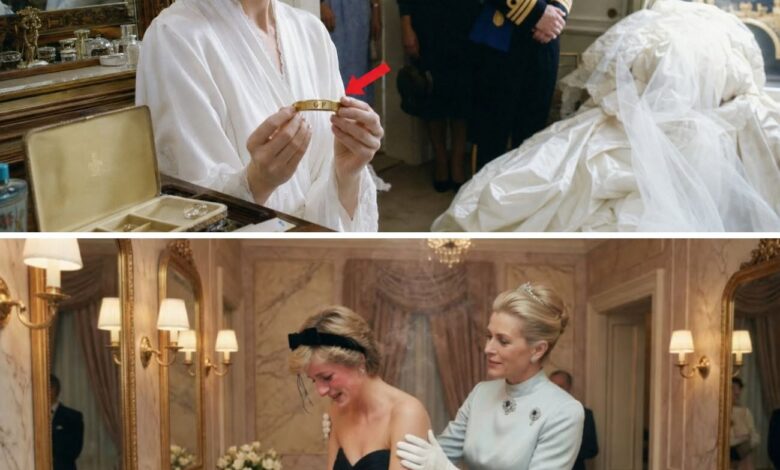
On the morning of July 29th, 1981, Diana sat quietly at Clarence House. Outside, London was alive with celebration: a million people lined the streets, waving flags, cheering with joy. Millions more watched from across the globe. Yet Diana carried something invisible to all but herself: a small gold bracelet engraved with initials that weren’t hers. Days before the wedding, she had opened a package at Kensington Palace to find the bracelet, knowing immediately it was meant for another woman. The initials “G and F” stood for private nicknames only Charles and Camilla shared. At twenty years old, Diana felt the weight of a truth no one around her acknowledged. She confronted Charles and was dismissed as being unreasonable. With no mother figure to guide her, no model of what a healthy royal marriage looked like, Diana could only hold the bracelet, put it down, and wait .
The engagement itself had been a whirlwind. Diana had met Charles only thirteen times before he proposed, addressing him formally as “sir” until that day. On February 6th, 1981, in the nursery at Windsor Castle, he proposed. Her laughter at the surreal moment was not delight, but shock. Eighteen days later, the engagement was announced live on the BBC. Asked if they were in love, Diana said “Of course,” to which Charles replied, “Whatever in love means.” Publicly, the words seemed innocuous, even charming, but privately, they left Diana confused and hurt. She understood then that love, in her situation, was complicated, conditional, and perhaps never fully reciprocal .
In the months before the wedding, Diana struggled with the royal system—the protocol, the staff, the cold, grand rooms. She described pining for Charles, longing for his attention while he was away in Australia, and feeling the emotional distance she could not close. Her first joint public engagement at a gala in Goldsmith’s Hall left her overwhelmed; she broke down in a bathroom, where Princess Grace of Monaco quietly comforted her. For the first time, someone saw the depth of her anxiety, a glimpse of the woman beneath the poised exterior. Diana was learning quickly that what appeared a fairy tale from the outside concealed a labyrinth of pressure and expectation .
The night before the wedding, Charles told Diana that he did not love her. She confided this to her sisters and considered not attending. But tradition, public expectation, and a sense of duty pressed upon her. Her sisters’ wry remark—that her face was already on commemorative plates—reminded her there was no turning back. Despite the emotional turmoil, Diana remained composed. On the morning of the wedding, she was “deathly calm,” carrying the knowledge she had held since opening the bracelet. The dress, a 25-foot silk gown, had hidden an 18-carat gold horseshoe studded with diamonds, sewn into the lining as a good luck charm. The carriage moved through the streets, past cheering crowds, towards St. Paul’s Cathedral, where she walked with her father, Earl Spencer, down the aisle to the altar with deliberate composure, holding everything she knew and hoped for in her heart .
At the altar, in a ceremony watched by three-quarters of a billion people, Diana made small errors under immense pressure, yet continued with grace. She pronounced Charles’s name incorrectly in her vows and noted later in her secret recordings, “I felt I was a lamb to the slaughter, and I knew it. But I couldn’t do anything about it.” Through the subsequent balcony appearance and photographs, she maintained a poised exterior, concealing the emotional weight she bore. Her calmness was remarkable given the private knowledge of Charles’s lingering affections and betrayals .
The honeymoon offered no respite. At Broadlands in Hampshire and later aboard the Royal Yacht Britannia, Diana’s hopes were quickly dashed. Charles wore cufflinks engraved with intertwined seas, a gift from Camilla. Diana saw them, confronted him, and argued. She cried quietly, privately, and realized that what she had sensed before the wedding—the truths encoded in that small gold bracelet—were real. The betrayal was subtle yet profound, and it would shape the next eleven years of her life, marked by public scrutiny, private grief, and a relentless need to maintain composure in the face of betrayal .
Diana’s insight and resilience extended far beyond her personal heartbreak. In later years, she applied the same quiet strength to her charitable work: visiting hospital wards, supporting landmine victims, advocating for AIDS patients, and giving attention to those society often forgot. These efforts, carried out between the divorce finalized in 1996 and her tragic death in 1997, reveal a woman who transformed personal suffering into enduring service. Through it all, the memory of that small gold bracelet remained a symbol of the first clear truth she encountered in her marriage: a truth she would carry quietly, without spectacle, through every public appearance, photograph, and official engagement .
Diana’s legacy is inseparable from the composure and foresight she displayed in private moments. In the late 1980s, for instance, she visited a hospital children’s ward in London. Sitting on the edge of a bed, she held the hands of a young girl, fully present, entirely herself, attentive to the child’s needs rather than the cameras or public eye. At thirty-six, years after her wedding, she remained a figure of care and empathy, qualities often obscured by the spectacle surrounding her. This capacity to be present, to provide comfort and attention quietly and fully, exemplifies the depth of her character and the true impact of her life beyond royal pageantry .
Through Diana’s story, one sees the intersection of innocence and duty, of expectation and reality, and of public spectacle and private truth. The bracelet she held became a metaphor for her understanding: that appearances are not always reality, and that strength is often silent. Her experiences demonstrate how courage, grace, and integrity can endure even under relentless scrutiny, offering lessons not only in public duty but in human empathy. Diana carried these truths, holding onto them for herself and, by extension, for the world that would come to remember her, long after the glittering spectacle had passed .